Thursday, October 25, 2007

An article on IIFMites, Development and Market Forces for Sampark, IIFM magazine

Completing 4 years of my sojourn in the development sector almost six years after passing through the lofty IIFM gate (the water tank) for the first time, I am reflecting about how the journey has been so far and what lies ahead for me… or rather, for us.

Always keen to work for the development sector since my graduation days, I joined the 13th Batch of IIFM in June 2000. Experiencing the course in the next two years made me sure that I was meant for the grassroots and so did both my OTs with grassroots organizations – SRIJAN and PRADAN. In the same spirit, I joined PRADAN in 2002 just 15 days after passing out from IIFM.

I worked with some of the poorest people of the country in the Vidisha Project of PRADAN, in a small place called Sironj. It was a real eye opener for me – I had no idea how hollow all claims of development, cried hoarse by the media, were. I witnessed the abject poverty resulting from a total failure of the development system – lack of basic amenities (health, education facilities, safe drinking water and proper roads existing only on paper) and rampant corruption in government agencies. My studies in Forest management were left behind somewhere; there was no forest to manage and in face of such grave deficiencies, even talking about rejuvenating the barren forest land felt criminal to me.

For a little more than two years that I worked there before leaving the job on the face of serious health complications, every day approached me with a new learning, not just as a development professional, but as a human being. One of the many things I was unable to understand was how a human being could exploit another in such a blatant manner! How someone could rob a penniless peasant for providing a copy of land records to him? How a health worker could refuse to visit his villages in spite of knowing about a disease killing infants like an unrestrained banshee? I was humbled as a human being; I felt ashamed witnessing it as a mute spectator. I did whatever I could within my capacity as a development worker and as a human being, but soon realized that the problem was not just the providers of amenities and the services. It was the community as well.

Centuries of colonial rule of the British has made the once self-reliant Indian villages and its community totally dependent on the system (read Government). Once all the resources of the village used to belong to the community. But in the beginning of the 19th century the market, and the resource-hungry British Government, took over all of them – land, water, forests, everything – and made the community totally dependent on it. Due to a conflict in interest between the government and the community, a series of famines followed, in which more that 85 million Indians lost their lives – not to disease, not to invasion, but to the greed of a colonial power. Unfortunately, no one even talks about these unfortunate compatriots who lost their lives to hunger then. Today, famines may have stopped, but the dependency has not. In Kankerkhedi, my first village in PRADAN, which has a population of 150, 14 people including infants lost their lives in just one year due to water borne diseases, yet despite having sufficient funds I could not get a hand pump dug there for a full year, as the community simply refused to deposit Rs.2500 as part of their contribution, mandatory in the Project in which I was working. They demanded to know the reason they had to pay when the government provided everything free (at least in principle, with all bribes and everything!).

Now, this particular aspect of the process of development makes it a little difficult. It is comparatively easy to create infrastructure – roads, houses, schools, wells, dams, etc. – but changing the attitude of a community is an arduous task. It is a slow process and all the more difficult when you are trying to do it in an environment which is otherwise exploiting and corrupt – the poor being taken for a ride by traders and big landlords, politicians, government servants and the mushrooming fly-by-night NGOs in connivance with each other.

However, in the recent past we have seen the attitudes of Indian communities being changed in many instances. The same market forces that once ravaged Indian villages in the form of the British East India Company are today changing the scenario of urban and rural India. A few decades back no one had heard of Maggie Noodles, Pepsi or Coca Cola. Today, colas have penetrated deep inside the Indian hinterland. At times you may not find safe drinking water in some remote corners of the country, but the mighty cola is omnipresent (never mind the CSE revelations)! Thus, we have witnessed that the community attitude can be changed in relatively less time, but it needs specific factors like an environment promoting change, desire and motivation to change, a foolproof strategy and huge resources to bring about such a change. This does happen, where market forces decide to provide a particular service or product in rural areas – not for charity but for profits.

The biggest and most visible example today is that of the mobile phone services. I remember, during my schooldays in the late eighties and early nineties there used to be a long waiting list for getting a phone connection. One had to either approach a neta or pay bribes to get a phone connection. Hardly two years ago in Sironj mobile phone was unheard of. Today I frequently receive calls from the Sarpanch of one of the villages who, calling from his cell phone, asks me which new Yojana is being dispatched by the Sarkaar in Dilli! Not just he, but many in the villages where I used to work have got mobile phones now, which is not a luxury for them but a boon to their remote villages that are cut off from the rest of the country for many months every year during rains.

Unlike NGOs (which have limited resources, vision and motivation) and the government (with its red-tapism, attitudinal and human resource problems), the corporate sector has huge resources, man power, access to the latest knowhow and the biggest asset – an ability to think out-of-the-box to achieve their goal. The biggest challenge in this case is how to link the problems in rural India to the market forces. In other words, how a problem of rural India can be translated into a corporate revenue model, thus transforming the problem itself into a solution. Can the human resources of villages be tapped as in China? Can our agricultural productivity be raised as in Brazil? Can there exist local BPOs operating from rural India? Can there be a wind power park on the coast of Orissa? Can there be a thousand megawatt super solar power plant in vast, sunny spans of the Thar Desert? All these ideas may sound impractical and too dreamy, but we have to remember, before petroleum was discovered, the Middle East was just another desert!

Here lies a great opportunity for IIFMites. With our exposure to rural India and its problems and our training in management, we can act as a bridge between the rural issues and the market forces. If some of us can come up with a feasible revenue model of linking one of these issues and converting it into an opportunity for the Indian corporate sector which is currently undergoing a boom, there is no dearth of capital for an off-track, yet feasible business model. The biggest example here is the foray of Reliance Industries and Bharti Group into the agribusiness sector with thousands of crores of capital. Another good example is the advances of ICICI Bank Ltd in rural banking and microfinance, which will literally capture the rural credit market in the years to come. To set an example as well as benchmarks within the IIFM fraternity, some IIFMites have already pioneered developing the linkage between the process of development and market forces. Vineet Rai (PFM 1996) with Aavishkaar, Mumbai; Sameer Singh (PFM 2001) with IFC, New Delhi; Deepak Mitra (PFM 2002) with Phillips India Ltd., Gurgaon – are a few among many in this growing genre of IIFMites, who are noted for having performed exceedingly well in this relatively less traveled path for IIFMites.

For the current IIFM batches, some more inputs from IIFM – in terms of some research in this aspect, more related courses of enhanced quality, distinguished visiting faculty from the industry – would go a long way in turning IIFM students into stalwarts of a new breed of industries: hybrids of corporate spirit and rural resources. At the same time, the students too have a major responsibility in bringing about this change. Rather than considering our course in IIFM as a ‘paid holiday’ (as one of my seniors told me on my first day at IIFM), we need to widen our horizons of knowledge working hard 24X7, keeping our eyes and ears open, reading and learning latest developments and looking for opportunities that would take us beyond the current trends in IIFM, lest the ‘paid holiday’ (sic) turns into a holiday that has to be paid for all through one’s life!

For those of us who have already passed out, probably the need of the hour is that the entrepreneurs among us come up with an idea out of their experiences in rural India and understanding of Indian economic scenario as of now. The pioneers in this venture are most likely going to leave a lasting impression on the Indian economy and society in the days to come. This is the ultimate opportunity to establish brand IIFM in Indian corporate and development sector with a paradigm shift in the perception of others for us, once and for all.

Wednesday, December 06, 2006

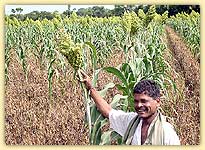
Jowar Mata (Mother Sorghum)-The Backbone of poor farmers in Indian villages


While the green revolution has considerably reduced the importance of grains like sorghum and maize in the Indian agriculture, the poor farmers still treat Jowar (Sorghum) as their mother- for the simple reason that it feeds the farmers with least resources- inferior soil, less rains and no or insufficient resources for fertilizers.
(Photo: Courtsy www.ativabio.com)


Before the Green Revolution (a dramatic increase in the food grain production in India) in the 60’s whereby the production of food grains shot up with the use of high yielding varieties (HYV), rapid use of fertilizers and irrigation facilities, particularly in the north Indian states of Punjab and Haryana, practically whole of India the farmers were taking food grain crops of sorghum and maize. The production was less and so was the economic value of these grains to support the market driven village economy. Because of this mostly these crops were used for bartering other commodities like clothes, vegetable and agricultural implements.


The green revolution led by Dr. M.S. Swaminathan with the help of the dwarf varieties developed by noble laureate Dr. Norman Borlaug has changed the scenario totally. The rural markets in India are dominated by various varieties of wheat and rice today. With a good production, these varieties have changed the economic and food security situation in these areas. Not only are these families more food sufficient as compared to the past, the cash flow in the rural economy has increased many folds, thanks to these crops.


However, this otherwise rosy dynamics changes when we think in the perspective of the poor families of the marginalized sections of the societies- scheduled tribes, scheduled castes, nomadic communities etc, who have very small landholding of poor soil quality and little or no credit availability for purchasing the high yielding seeds, fertilizers and pesticides. In such situation, the high yielding wheat verities are of little use to the poor farmers.


So they depend on the humble crop of past-Jowar. Marginal farmers (with small piece of land of poor soil quality and less water for irrigation) rely on Jowar for the food security of their families. The modus operandi is simple- borrow bullocks and plough from a co-villager, plough the land and sow Jowar seeds, with little or no fertilizers. Like a caring and understanding mother, Jowar grows very well in even the most undulated, rocky soil with little water retention capacity, depending totally on the rains or the residual water in the soil for the irrigation and feeds the family like a mother with its humble offering.


Even 2 quintals of Jowar from a small landholding of one bigha (one fourth of a Hectare) provides the poor family a food sufficiency for two months. Also, during this time, since they are not working in their own lands, they find employment in the fields of other people for various crop related operations and earn enough money to sustain their family for another 2-3 months. Jowar provides good amount of fodder to the cattle and is used in many places for fuel and thatch as well. No wonder its called Jowar Mata (Mother) by poor in many parts of the country.

Monday, September 11, 2006

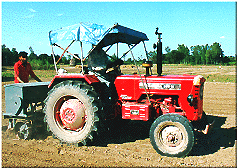
Tractors- vehicles of development???


Tractors- do they really mean development?
Many of us consider tractors as a general symbol of development in rural India regardless of the profile of the family owning it. Probably tractors as symbols of development have been borrowed from the western societies but having spent sometime at the grassroots, I beg to differ.

First of all, the cost of purchasing a tractor is very high even for a well to do big farmer. Although through subsidies the total cost of a tractor may be around Rs.4.5 lacs, but farmers seldom are able to purchase them by offering cash up front. Rather they have to get it financed from the banks, and the yearly installments for the same comes to be around Rs. 80,000/- which, by all means is an astronomical amount for small and medium farmers. Add to this the cost of maintenance and diesel and the actual money required to have a tractor shoots through the ceiling. The farmer eventually has to pay about Rs. 7-7.5 lacs for even the low end 25 HP tractors and when they are unable to do so, the tractor, which is under hypothecation with the bank is snatched away and auctioned off.

For this threat, many a times the farmers are forced to sell off a portion of their land to pay for the installment of the tractor, which actually makes them poorer rather than adding to their riches by creating a vicious cycle of reducing means of production and increasing the liabilities. Probably for similar reasons, even Mahatma Gandhi opposed the mechanization in agriculture in his book 'Hind Swaraj' written in early 30's.

So, what is the solution?
In my opinion, it is much better for a small or medium farmer to hire a tractor during the crop season on rates varying Rs.400-450 per hour rather than purchasing one. It limits their liability, keeps the cost of maintenance off, and best part- provides employment to another villager, usually a young entrepreneur. The basis for this argument is that the tractor is not able to support its cost if it does not works in at least 10-15 hectare land for various crop operations like tilling, sowing and weeding. Thus any farmer having less than these much land either has to hire out the tractor to the other farmers or bear losses.

So simple! Then why the hell do they get one in the first place?
The question is, if they can not afford to have a tractor, how and why small and medium farmers end up getting a white elephant to their home? The answer lies in the greed of tractor companies and the bank managers. The tractor companies are always in the look out for increasing their sales. For this, they employ agents in the nearby villages who act on dealer’s behalf. This dealer is, in turn, connected with the bank managers of Commercial banks as well as the Regional Rural Banks and Land Development/ Cooperative banks which have got targets to finance tractors under various schemes. Financing a tractor is their favorite finance plan as it is a big transaction and they need to conduct fewer such transactions to achieve their targets rather than going for many smaller transactions like those involved in funding a diesel engine.
The Gameplan of Tractor dealer
The agent in the village provokes the fancy of the farmer, whets his ego by promoting tractor as a mean to show that he is a big guy in the village and brings him to the dealer. The dealer, at times pays off some amount of the initial deposit required for the bank by providing a loan to the farmer on exorbitant interest rates and keeping a blank stamp paper with the farmers sign or thumb impression on it with his land record as a security. Then he gets the tractor financed by the bank, but not before the manager extracts his pound of flesh in form of bribe from the farmer. Thus, the deal is struck. The dealer gets his margin, the agent gets his 'cut' and the manager gets the increment as well as the bribe, but the farmer pays through his nose for all of this.

That’s how another farmer is drawn into the debt trap for the so called symbol of development. Adding to the existing number of tractors in the village, it further reduces the rate that a young entrepreneur was getting as tractor hire and thus the farmer not just hurts his financial interest but also that of others in the village.

Later on, as the farmer is unable to pay the installments in time, he sells of some of his lands, and ultimately the tractor is either snatched off by the bank or the farmer has to make a distress selling to some biggy of the village to pay off the remaining amount of the loan.

It is evident with this that selling tractors to small and medium farmers- without any ethical considerations about their paying capacity and how it would effect their finances in the long run- is ruining thousands of farmer of India.

Is anybody listening?

Thursday, July 20, 2006

A mail- September 2005

Here is a mail that I wrote to members of IIFM Alumni (at yahoo groups) in September 2005 after Katrina struck some parts of US and horrifying images from New Orleans filled our living rooms through various News Channels.
Although this incidence was one of human suffering and tragedy, some sections of Indian Society tried to use this opportunity to draw comparisons between India and US; trying to prove that India is superior to the US - as we were able to address the floods in Mumbai in a better way the US Government did in case of Katrina. One such mail was forwarded in the forum.
I felt hurt with this opinion and wrote back to the forum my opinion about it. I had almost forgotten about this mail, when I recently saw it posted on the blog of one of my seniors from IIFM quoting my mail. I am reproducing the same here to make it a part of my blog on issues of development in India.
"Dear All,

This mail is in context of the recent comparisons drawn between US and India by certain sections of Indian society. Some of us agreed to that point of view and some did not. With this mail, I am trying to put in front of you my thoughts on this. I would like to request you not to view my thoughts as some kind of generalization. Our country is so vast that it is impossible to state a fact that applies true for each and every nook and corner of the country. Whatever I am expressing is based on my personal experiences as well as the information that I could gather from the newspapers, books and articles, as well as the experiences of my friends and colleagues working across India. Please feel free to disagree where ever you think I am wrong and point it out to me. I would be grateful for the same, as you would help me in getting over some of the number of imperfections that I have as an individual.

In the midst of all the development that has been happening, India scaling new heights in many fields, growing confidence of Indians, booming Indian economy (Sensex breaking the 8000 ceiling), new jobs and avenues that are being created, Indian IT professionals dominating the silicon valley, recent Goldman Sachs report of India being one of the economic superpowers in coming few years and our comparisons of the tragedies-Mumbai and New Orleans, there is a threat of us becoming complacent and start blowing our own trumpet while the world moves on. I don't have the slightest doubt about the capacities of us the Indians and the potential that our country has to become a non-belligerent, supportive superpower (unlike the US) in the days to come, but, in words of Robert Frost- '...miles to go before I sleep....'.

Disparity in Indian society is growing by the day and there is a total system failure in terms of the education, health, livelihoods and law and order in many parts of the country.
So, while many of us in past few years have been promoted from the Indian Railways to Jet Airways customers, there are still millions of our countrymen who don't have access to a pucca road on which they can travel to the nearest haat with their produce in their Ox-carts. While the galloping Indian economy in developed parts of the country treads on the six and eight lane highways, most parts of the country are still inaccessible for whole four or five months of the rains- unfortunately this is the time when the morbidity and mortality due to various diseases is at the peak and the people desperately try to reach the nearest block or town for medical assistance.

While we in metros see the vulgar display of wealth in terms of new longer and costlier cars, expensive consumer goods and shopping malls full of the best products of the world market, millions of our compatriots are still going without two square meals a day.

Bonded labour, in form of Harwaha system is still going on in our villages. So, for Rs.8000 a year (A year, mind you, not a month), it is still possible to have a dignified slave to work for you 14 hours a day in our villages. Most of the times, it is poorest of the poor SC and ST families of the village that get into the cob-web of this system.

While in our cosmopolitans, corporate hospitals like Max, Apollo and Escorts are coming up, in most of the rural areas it is the Quacks (Jhola Cchaaps), who are not qualified enough to treat animals are treating human beings for diseases ranging from common cold to cancer. I witnessed in one village of Madhya Pradesh of population 160, 15 people dying in one year, of which 11 were children below 15 years of age and 12 of the dead had died because of lack of safe drinking water.

With all hungaama in the name of IT in rural India, the farmer is being charged exorbitant amounts for getting a copy of his land records by the soochak of the Gyandoot Project in Madhya Pradesh. E-governance is still a distant dream for most of the districts in the country.
On two ends of the spectrum, NGO activists are either making wealth or are getting killed for their work and rapport with the community depending on the degree of integrity and honesty that they display. They are finding stiff resistance from the stablished players of the rural and urban development- government officials, and businessmen who are hand in gloves with the corrupt and inefficient Government machinery at many places.

Forests are vanishing, despite JFM, SFM and whatever Forest Management, many forest areas are rapidly turning to deserts. Our tigers and leopards are being poached at alarming rates to be sold in the international markets and danger of extinction is looming large on these magnificent animals. All this goes on while we are trying evade this reality by burying our heads under the sand like an ostrich.

Other natural resources are fast depleting- worst hit is water which is being recklessly pumped out in whichever areas it is still available. Land quality also is depleting due to the reckless use of fertilizers and pesticides in agriculture and improper management of organic matter disposal. People turning towards the cash crops for more and quick income have also got a bearing over this situation.

Governance has become a victim of politics, corruption and vested interests of individuals. While the numbers of management institutes and engineering colleges in India have gone up drastically in past few years and in some parts they have come up like mushrooms, churning out tens of thousands of engineers or managers (so called) a year in a single state, in many other parts of the country there are only two or three 8th pass persons in the whole village!

Atrocities on weaker sections of the society- the poor and women- is common in rural areas and in some ‘disturbed’ states of India, it has assumed dangerous proportions. All said and done, the persons from both of these categories are still being subjected to a second rate citizen treatment and this practice is continuing unabated in many parts of the country.

Separatist movements are going on in many parts of the country, with a lot of bloodshed and brutalities both by militants and security forces. This has support of many countries who don’t want to see a strong India and are ready to go to any extent to check the movement of Indian juggernaut in the direction of becoming a developed nation. Lack of development and prosperity in these areas are helping the separatist movement by providing a pretext of these movements to drag in the youth into this.

The crux is- there is no chance for our country to think that we have achieved what we wanted to achieve and relax, even for a minute. They say- ‘Rome was not built in a day’ and neither would be our country.

My intention is not to dampen the spirit of India emerging as a developed country. I am a total nobody to say this, considering all the big-wigs are going gaga about the achievements of the country in the recent years. All I want is to point that lets not get complacent with the achievements of our country so far. Let’s not start relaxing so early and start living in a false sense of well being, as all is not well.

If at all this is going to be a triumph for the nation, it is just the beginning. The fight has just started and a lot of struggle is ahead. There are millions of Indians waiting for their fair share in the development of the country. With the growing rhetoric about privatization and commercialization a panacea to all problems of the country, there is a chance of dumping this responsibility totally on the market forces (as we had done in past, dumping the total responsibility of development of the nation on the government and its agencies, and there by making them feel like God- all pervasive and omnipotent- without any answerability whatsoever). None of them- either the Government or the Market- would ever be able to single-handedly perform the Herculean task of the development of the multitudes of our country till the time we, the individuals assume a portion of this task as an individual responsibility and do our bit about addressing these problems.

And for this, the first thing that is required is a lot of soul searching and a well participated discussion amongst us, and to find out the exact role that we can play and how to optimize it in the favour of the Indian version of the Chinese Long March that we are witnessing. In a way, we are in middle of making of the history- emergence of the modern India as a developed country. It is akin to the freedom movement and as we ask our previous generations, tomorrow’s generations are going to question us how we participated in this process and what role we played in this. Victory or defeat-in both cases, we would be responsible for some role or the other. It’s now up to us, what we want to be- performers, or the fence sitters.

I would like to quote Late Dushyant Kumar, one of the famous Hindi poets of modern times before I close.

‘Ho chuki hai peer parvat si, pighalni chahiye/
Is Himalay se koi Ganga nikalni chahiye/
Sirf hungama khada karma mera maksad nahin/
Mera maksad hai ki koi tadbir nikalni chahiye/
Mere sine mein nahin to tere seene mein sahi/
Ho kahin bhi aag, lekin aag jalni chahiye……"

Friday, June 23, 2006

A Post on Delhi- for a change!


How I landed up in Delhi
In June 2004, I left PRADAN with a heavy heart. A part of my mind asking me to stay where I had spent some of the best days in my life, working with some most poor, yet the coolest people, and I lived a part of their life on a daily basis. I am going to discuss this separately, as many readers of my blog send me mails asking why I left PRADAN when I loved it so much.
Obviously, it was a painful episode for me, and I am sure, many others- my friends in PRADAN and more then them, some of the beneficiaries who had started treating me as their family member. I am waiting to write that part of my story; and so would you have to!

After leaving PRADAN on 30th June 2004, I went to my parents at Rewa, my home town, to spend some time with my family. It was also a necessary break for me to get a break to relax, rest and recuperate. I spent about 15 days in home, talking to my ailing grandfather, who, in many ways, is my ideal in life. I also discussed future with my parents, who were not very convinced with my leaving PRADAN without having another offer in my hands. May be they were feeling insecure, and to some extent even I was, but one thing was sure in my mind; I could have stayed in PRADAN looking for a job, biding my time, but that would have been a treachery, not just with PRADAN, but more importantly with the community, as healthwise I was no more in shape to do justice to my work in PRADAN. I told my parents that I have got enough savings to sail me through my days of unemployment, and besides, we still have our land of 11.5 acres in the outskirts of Rewa. I told them what I had told one of my colleagues in PRADAN- “Thanks to PRADAN, I know how to cultivate soyabean and wheat. I have some idea of cultivating vegetable as well. So, if I don’t get a job in 2-3 months, I would simply come back and become a farmer in my home.” I knew it was easier said than done, and was also confident about getting a job in Delhi.

With this background, I landed up in Delhi in the third week of July. Madhukar, who was with me in PRADAN and was in fact my room partner there, had reached Delhi a few days earlier after quitting PRADAN to pursue higher studies (read MBA). He had already taken a house in Khirkee Extension (Malviya Nagar) with help of Cchavvi and Haresh (ex-apprentices in PRADAN, Sironj).

A Party Going on?
I distinctly remember, it was a Saturday when I reached Delhi and unfortunately lost my way in Malviya Nagar. The autowallah dumped me on one of the intersections after taking his charges, and here I was, in a very bad shape, long hair, a day’s stubble, dirty clothes due to the travel and holding a bag and a suitcase- on a typical Saturday evening of Delhi. Having lived in villages for two years- I was looking at everybody passing through with wide eyes. Latest bikes, luxury cars, well dressed young people, an overpowering fragrance of a variety of deos, cologne and talcs in the atmosphere, car stereos blaring music all around- and I was looking on, as I had never seen this ever. ‘What is this’, I thought, ‘is there a party going on somewhere?’ I was soon to realize that this ‘party’ is a pattern of life in Delhi and probably in other metros of the country.
A Cultural Shock- but the poor remain poor

It is a cultural shock when a guy like me hailing from a small town and having lived in rural areas comes to Delhi. For days all I kept doing was to compare this life with that life. I and Madhukar used to discuss about our days in PRADAN and how things are here in that comparison. Our flat was in one of the dirty alleys in Khirkee and fortunately there was a balcony in which we would stand in the mornings. Here we came to know that by no means is the number of poor less in Delhi, no matter how insensitively we try to push this issue under the carpet.
Because of our orientation, we would see number of poor coming to sell something or the other. The first ones to come are the Koodawallah or the janitors who collect the garbage bags from each house and take them away for disposal. With them there are people selling the vegetables, along with the night watchmen who start their second shift by washing cars, making Rs 100-150 per month per car. They are joined by the drivers of school vans along with those of the call center cabs who ply 24X7 like their occupants. There would be a second wave of these street vendors- people selling incense sticks, house hold articles, utensil repairers, cobblers, The third wave is of delivery guys (some providing 20 liter cans of mineral water, some providing pizzas, burgers or other eatables), There are religious people- sadhus, shani maharaj and fakirs who are grateful to the religion for their livelihood. All these people would keep coming and going throughout the day. As both of us were out of the job, we would observe all this throughout the day and were quite amused in finding so many ways by which poor in Delhi earn their bread!
There are thousands of taxi drivers, porters, loaders and domestic servants that keep this city going. They are at the bottom of the pyramid that concentrates the surpluses at the top. Apart from the apparent availability of jobs, there is hardly any other factor that makes their life better in Delhi than what they use to live in their homes- small Indian towns, villages and hamlets.

A Dirty Secret of the National Capital
The other day I came across a gentleman in my neighborhood who maintains a Mercedes yet lives in a rented flat. I asked him why and he told me one of the little acknowledged secrets of Delhi- the prevalence of a covert money lending system.
He said- “Why should I block my money in the flat? I’d rather lend it to some small timer. It fetches a great interest.”

“How much?”

“About 10% a month”- the guy said coolly.

My jaws dropped. 10% a month is a whopping 120% annual rate of interest!!!

“How do you make sure that your money comes back?” -I asked.

“Ha ha ha! Do you think any of these poor rascals have guts to embezzle MY money?”- said the gentleman, menacingly.

Now you know how money earns more money in a materialistic system like ours!
(to be continued)

Friday, April 21, 2006

Are The Indian Villagers Ignorant?


I wonder how many of us would have heard that joke about a urban crook who is into printing counterfeit (naqli) notes and once, by mistake, prints notes of 60 instead of 50. They are about 10 wads of them, and this guy doesn't know what to do next. So he decided to do what many have done, to take a villager for ride. He reaches a village and finds a person smoking bidi under a tree.

Our urban crook tells him- “I have got 60,000 rupees here, I can give you all this for just 30,000.”

The villager says—‘Really? Hmmm. This sounds interesting to me! Just hold on, I am coming back with money in a second!”

So he goes off to his home and comes back after a while carrying some wads of money that he hands over to our conman, taking money from him. Amazingly enough, there are 10 wads of them, all of Rs 30/- rupee notes!
Never underestimate a gaanvwallah!
Unlike the common stereotype that many of us carry- villagers being naïve, I got an entirely different picture as I interacted with the Janta Janardan of India. Here's an incidence on this.

During my PRADAN days, one of the villages that I was entrusted to was Sugnakhedi, a OBC (Kushwaha, Kirar) dominated village with a considerable number of Harijan families. It was about 17 kms of kuccha road from Sironj, where I was stationed.

Our modus-operandi working under the DPIP (District Poverty Initiatives) project needed us to do a wealth ranking in the village before starting the actual work. Coming back from a PRA (Participatory Rural Appraisal) workshop at PRADAN’s Kesla office, we decided to use the locally available stuff and villagers understanding of the community to conduct a wealth ranking in this village.

So, after purchasing some choona (lime powder), haldi (turmeric) and sindoor (vermilion), we reached the village and started talking to some of the villagers. Although this village was far, and we were three (myself, Madhukar and Jeetendra-who was a newcomer then) we decided not to hire a Jeep for reaching this village, as Jeep is associated with the Government and people coming on a Jeep to any village announces the arrival of either trouble or free pre-election sops in the villages. We did not want to convey either of them. So, we decided to ride on our bikes to the village.

As we gathered on the village square, many villagers surrounded us, inquisitively. We asked them to gather in one of the dalaans (verandah) of a house and sat their on the floor mat along with the villagers; following the PRADAN’s rule of equality. As we started discussing things with them, we told them that we are from PRADAN and we have come to study their village. We intentionally did not give them the information that we are their for the implementation of DPIP as there was a threat that knowing about a multi-crore project all of them would give us biased information , particularly about the economic status, depicting all of them as the beneficiaries. (I don’t understand why government projects have to distinguish between poor and poorer and the poorest and give support only to poorer and poorest and not the poor. There is no such thing as a rich person in the village as whoever is rich, is, most of the times, out of the village, residing in some town, and acting as absentee landlord).

Anyways, we told them that we are here to collect some information about the village and this is a kind of survey that we are doing, without referring to any Project involving grant or loans. Initially they were reluctant to discuss anything with us, giving us an impression that they are disappointed with the fact that we are not from any project offering sops to them, but later on, upon our insistence they agreed to give us some time. So we settled in the daalaan and asked them to help us in making a rough map of the village on the ground by using the choona, haldi and sindoor that we had taken with us. They started off in a very slow way, but gradually the exercise picked up the momentum and the participation increased as the villagers were trying to correct others wherever they depicted the village map in a wrong way and missed some house or a handpump. Within an hour, we had a lovely map of the ground prepared by the villagers (just like a rangoli) on the ground. We helped them mark each one’s house by writing the names of the people on small pieces of paper that we had taken with us and thus created a villagers’ GIS (Geographical Information System) giving vast detail about the village- locations of the caste specific sections of the village (tolas), location of the handpumps and their proximity with a particular section of the village, location of the temples, school and the rivers, irrigation wells, fields and grazing lands. This was a great success for us also as the facilitators as we were able to get the villagers draw this on their own and the accuracy of this was better than any other data that the government or nay NGO like us would have.

After this, we came to our real exercise, although we did not announce it. We decided to carry out the wealth ranking of the village by using the name tags that we had created in the process of marking the house owner’s name on every house on the map created by the villagers.

We had decided not to use any word that suggests the economic level of a person (words like gareeb, ameer, paisewala, dhani) so as to not to alert the villagers that a screening exercise is about to take place, lest their views become biased with vested interests and they try to prove those people poorest who were actually not. We tried to ghumao (sugarcoating the real fact) them by saying that not all five fingers in one’s hand are equal, and therefore in the village also everybody is not equal. Somebody is ore happy and some body is less happy. So we tried to keep ‘happiness’ as the indicator of well being rather than the ‘wealth’. So, we created three faces on the ground- one smiling, another sad and third one normal (neither smiling, nor sad) and asked the villagers to drop the name tag of every person on one of these, depending on their current stithi (circumstances).

They started off, and after a while we could see a discussion going out about a particular person.

One villager- “Put his name there. He is in the worst circumstances!”

Other Villager: “Who says so? How is he in the worst category?”

First Villager- “ I say. Don’t you know he doesn’t have any land or any cattle?”

Second Villager- “Ha! So what? He is a postman, he gets 3000/- per month from the government! Dare you call him a person in worst category!!”

We were glad hearing this- “So, ultimately, PRA works! Great!!!”

The exercise went on for about an hour and half and in the end, we had a list with us, with all the villagers in one of the three categories.

“Cool man! That was superb!”- one of us exclaimed, our way home.
An Eye-opener

However, in a few weeks from then, our happiness was to get thoroughly crushed when we got to know that there were some wrong selections in the wealth ranking that we have generated in a ‘professional’ way.

We came to know that three brothers of the village were placed one each in the each category. Initially, we thought it is one of the aberrations, but later on, to our horro, we discovered that it is a trend!

The clever villagers had not only understood our ploy but they had also outwitted us in our own game by putting family members from every family in all three categories so that no matter from where we start, we would have to include at least one of them as the beneficiaries. I am still at loss understanding that how the villagers of such a remote village got to know the intricacies of a wealth ranking camouflaged so well by us. May be they had got to know about this process from the nearby villages where we had earlier undertaken this process, or may be it was instant insight that they got about wealth ranking.

Whatever it was, my remaining doubts about the naivety of the villagers were laid to rest with this incidence. The villagers of India are not ignorant, they understand the gimmicks played by us, the so called educated of the society. It is just that they are either not in the position to refute us, or they too have adopted the malpractices through which they are taken for a ride as a part of the system, which cannot be changed and that corruption is a eternal truth.

“Bhrashtachar (Corruption) has become shishtachar (etiquette)” - One of the enlightened Indian declared once.

That is the reason why I and my colleagues at PRADAN used to get so many questions when we used to go with the villagers to open their groups’ savings account. After filling their forms, taking them to the manager and getting account formally opened in the books of the bank, when we would hand them over their passbook and cheque book, the villagers would ask us -“how much we need to pay you for this?”

“Nothing. Why should you pay anybody for opening an account?”

“That’s what had happened last time when so and so of our village had gone to open an account under so and so project. That guy had charged him Rs.500/-!”

“How can it be true?”- We would ask ourselves, “who would be the heartless person to con Rs.500/- from such poor people who don’t have enough to eat?”

Take my word, the wolves may have vanished from the jungles of India, they still thrive in Indian villages on the blood and bones of these unfortunate compatriots of us, who are half dead, courtesy a callous system that takes pride in calling itself ‘a democracy’.

“Hey Ram!”

Yet another window to the 'Real' India

Mindset of a poor

Visiting a village in most of the rural India is like visiting another world. Beyond the flamboyant metro culture of big cars and bigger houses, ever growing lust for consumer goods that drags you into a meaningless rat-race of more, more and more for I, me, myself, there lies another India where people live in a here and now situation (not because of the famed duo of Dipankar and Ramesh of PRADAN PAS made them so, but because of their hand to mouth existence). One can plan for future when his or her present is secured. When a person knows that he has only today to live in, he tries to live it fully, up to its last moment, trying to drink the last drop of the elixir of life from the cup of today. We were disgusted initially when we would see a poor man buying commodities (supposedly luxuries- bidi bundles, clothes, ornaments) for every member of his family member the day he gets some cash upon selling his harvest.

“Save it”, we would tell them, “put it in the bank so that you may use it later.”

But for them, there is no later. All that matters is today, life is uncertain. They would like to marry off their daughter, or buy a necklace for their wife rather than investing it anywhere.

“Kal kisne dekha hai, bhaiya”, they would ask me, “aaj haath mein paise hain, aaj maja kar lete hain, kal jab aayega, dekha jaega.”
(“Who has seen tomorrow, brother? Today I have money, let me make merry with it. I would worry about tomorrow when it comes”).

Such is their insecurity about the life ahead. People who you find working today are no more the very next day. They die in the harness like the war horses. I can elaborate this by an example. On a day of my regular visits to my favorite village of Kankerkhedi, I reached the home of Hari Singh, one of the PRADAN service providers. He was not at home, but his father was their, doing some carving on a big wooden door frame. Upon my asking him why he was making so much effort on carving on he door and not putting it directly on, he told me that one should leave something different behind, so that upon his death his children and grandchildren should remember him by his works. I left the village that day contemplating about the pearl from him, an elderly man that he was. Next day, when I came again pursuing some work, I found the whole village deserted, only women and children to be seen in the alleys of the village. I asked one of the ladies, who was a member of the Self Help Group that we had initiated there about it. She told me that all of the men folk have gone in the lakdi.

“Lakdi (wood)? What’s that?” - I asked.

“Oh, you don’t know?”- She said- “Hari Singh’s father expired yester night. All the men have gone in his cremation (lakdi).”

“What???”- I exclaimed- “but yesterday he was here, working on the door frame when I met him?”- I said, baffled with this information, the old man’s face and the discussion that we had previous day being replayed in my mind.

The woman displayed a painful smile-“That’s how things are for us, bhaiya. Today you are here, talking to me, tomorrow you would come to find me gone. We are no better than animals.”

On my way back home, I was thinking why is it that even after 55 years of swarajya our people have to consider themselves animals. How can a seemingly ordinary stomachache kill a healthy person in a matter of minutes? I was pained to think how a son can see his father die in a matter of minutes so helplessly and that too not by some accident or some dangerous disease but water borne diseases.

How exactly did the father of Hari Singh die, no one would ever know because no body was bothered to know. After all, what was he? A poor, old man owning a few bighas of land in some unknown village of a less know district of the backward state of Madhya Pradesh. How does his death affect a fattened corporate honcho or a shrewd political fountainhead or, for that matter, a common man on the street of the capital of his country, where a Yamuna of wealth flows after the original Yamuna has been converted to a huge, open drain? There would be no obituary, no media coverage, no national mourning for him, because he was the common man, he was the Janta Janardan.

This was not the only death that I saw. There were others who dies in this strange way. There would be a terrible stomachache, and by the time one would even get on board the Sironj bound bus for diagnosis, he would be dead. I saw at least four such cases in this village where grown up people died, what to talk about the children?

Government’s Reaction

Not that I did not try to do anything. At the very beginning, I had noticed the dearth of the safe drinking water in this area and decided to take this up with the local government hospital. One fine morning when I reach the superintendent and told him the whole situation, he was livid. “Just who the hell are you?”- He frowned at me. I told that I am an NGO worker taking care of the poverty alleviation project in some of the villages there. His next question was- “You mean to say there is an epidemic in this village?”

“No”, I said, “That’s not my job to declare that there is an epidemic. You are a doctor, you should come there, see for yourself and then decide whether it is an epidemic or not. All I am telling you is that there are about 90% villagers suffering with water borne diseases and having loose motions. I am wondering for how long your department has not chlorinated the drinking water well there.”

He called the Village Health Worker and scolded him in front of me. He told him that today it is an NGO person raising voice, tomorrow it would be all over the press and media.

“Do something”, he said, “Lest it becomes an issue for us.” Clearly his concern was not the dying children but negative publicity and subsequent fallouts. Anyways, the well was disinfected by using chlorine after some days, and that’s all we could do.

Unfortunately PRADAN keeps it away from the health related work (something that always bothers me) and so my interest in health was not supported much as they would have been supported had it been a livelihood activity.

A Bucket full of holes

My doubt is how can be the development of a people compartmentalized into livelihoods, health or education? How can we ask a person to form a SHG or do improved agriculture when s/he is dying of diarrhea? How, as a human being, I can turn my head away when I see some issue that is not exactly livelihood. In PRADAN we saw that many a times the poor family had an average annual income of Rs. 12,000 to 15,000 (collected in 2004, that is not a very old data, it may hold true even now!). We were told that even if we were able to increase it by 5,000 an year, it would be a boon to the family. We tried to do this by using all kinds of livelihood and microfinance interventions and achieved it, only to find that one person falling ill in the family, one death, one marriage wiped it out. One year of hard labor, the toil of the family as well as the NGO worker, just vanishes in a jiffy! No matter how hard the family works, it is bound to remain poor if good health is not ensured to them, for the bucket that they are trying to fill is full of holes, from which water flows away the moment it is poured.

Unhealthy body, unstable mind

Bad health affects not just your body, it affects your mind as well. The financial indiscipline that we see in the rural areas (taking loan and not repaying in time, or using it for purposes like marrying off some distant niece) is borne by a strong sense of insecurity in mind- the instability that future represents to these rural peasants. ‘Tomorrow’ is a big question mark for them.

“Kal kisne dekha hai, bhaiya. Aaj haath mein paise hain, aaj maja kar lete hain, kal jab aayega, dekha jaega.”

This is the sense that drives the mind of the poor who are not sure from which quarter of life the next shock will come. Then there is the general callousness that the educated society and government officials display towards them. People are still not allowed to sit in front of the government babu in the tehsildar’s office. The Janta Janardan still squats on the floor along with the dirty rubber slippers of the wealthy money lender. They still run after the bikes of people like me to get themselves enlisted in the poverty alleviation projects.

Reality Bites-A distant Banjara village

Upon reaching Panchmarhi, another border posting of mine, I was surrounded by the villagers. I had gone there to do the village study and so was hiding my real identity of a PRADAN worker, because once they know that I work for the Poverty Alleviation Project, all of them may project themselves to be abjectly poor, in order to get listed. This had happened a number of times earlier, and I was pretty sure this would happen here again. So, I hid behind the half-truth (ardhya satya) and told them that I was there to write a report. An old man (must be in his 80’s) was watching me intently, keeping quite through out the discussion. Finally, when he spoke, everybody fell silent, may be he was one of the village elders.

In a very low but clear voice he started speaking-
“I don’t know who you are, and why you have come here. Good or bad, whatever your intention may be, I am happy. I am happy because after decades somebody has come to this distant village to ask if we still exist. It doesn’t matter if you do something for us or not, but I am happy that you have cared to come to us and are treating us as human beings.”


That day I was moved to my foundation. Here is a part of our country which is happy that somebody is coming to at least headcount them- forget about providing them the basic amenities that we promised ourselves so proudly as declared in the preamble of our constitution decades ago. Just where is the ‘India shining’? Where are all the chest beating jingoists of this country who claim that India is going to be a superpower of sorts in a few years to come?

“We are already an economic superpower”- many of my friends would say, if reminded about these issues- “Problems are there, but why should be not celebrate the successes so far?” –they would shoot back.

Of course we should. We should celebrate the nuclear pact when our compatriots don’t get the safe drinking water. We should dance to celebrate in the pubs and malls when their houses remain shrouded in darkness. We should decorate our houses and fire crackers worth thousands when they don’t have enough oil to cook their food even.

After all, it is not my house that is burning; it’s their hut on fire. I would react when a spark would fly to my palatial verandah! Till then, I would play the flute, as Nero did, when Rome burnt to ashes around him.


Is this what they call- 'Drink thunder'?

That day, there were many firsts in my life. For the first day I reached a village where they had expected me the least. For the first day, my urban pride was humbled by an old nomadic banjara. For the first time, I drank water directly from a seasonal river, like the poor who live in these unknown corners of our so called largest democracy of the world. It was a brownish mix of water, decayed leaves, mosquito larvae, mud and other wastes. Today, I see poverty and wretchedness being discussed in air-conditioned conference rooms of the capital. Whenever a mineral water bottle is placed in front of me, I am reminded of that Banjara community. Those smiling faces, who did not lose their charm in the scorching heat of poverty and backwardness, those open hearts which did not hesitate a second in sharing their two chapattis with a stranger, those hopes that I could see in their twinkling eyes- not at all seen ever after in my life so far.


That reminds me of the famous poet Dushyant Kumar, who once wrote-

“Kahan to tay tha chiragan har ek ghar ke liye
Kahan charag mayassar nahin shahar ke liye…”

(Once we had decided to provide light in every house, but now there is no light for an entire city…)

Swarajya (Self-rule)

Under these circumstances, is it wrong for a village like Mendha in Garhchirolli district of Maharashtra to seal its borders with rest of the world, take the administration in its hands after declaring itself a village republic- and raise the slogan

“Dilli-Bambai humari Sarkar
Humaare gaon mein hum hain Sarkar”

Our government in Delhi (central) and Bombay (state), but in our village, we are the Government!

As a utopian dream, don’t we talk of the empowerment of the communities to the extent that they can make and maintain the rules to govern their lives? Is Mendha not a crescendo of all our community enablement swan songs?
After all, didn't Tilak roared a century ago -
'Swarajya is my birthright, and I shall have it!"

(Based on my experience in Mendha village that I visited during my attachment with North Chandrapur Forest Circle in December 2001)

Tuesday, March 28, 2006


Success! Gangaram Kushwaha, Chairman of SCPCL, PRADAN Sironj's seed enterprise with farmers on the Offtrack column of India Today, April 3, 2006. Congratulations to PRADAN and the farmers it is working with in Sironj!  Posted by Picasa

Friday, March 10, 2006


The PRADAN team who keep the Tiranga flying high by working tirelessly for the upliftment of the Poor, even at the cost of letting go the easy life of the cities. Three Cheers to you, Guys! Posted by Picasa

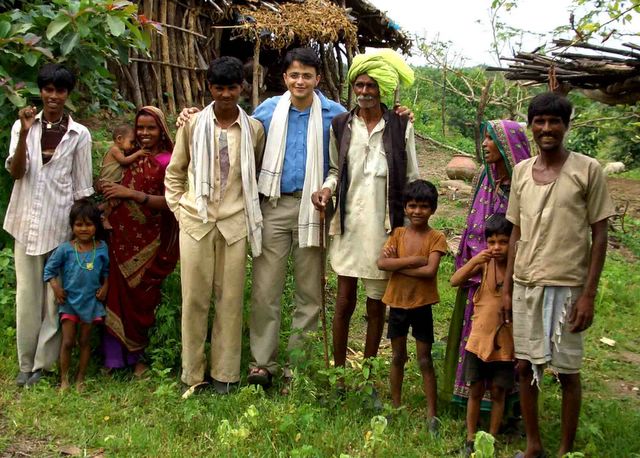
My patrons at Kankerkhedi- Arjun, his parents, wife and kids, brother and cousin Posted by Picasa

Madhukar with a Banjara Woman in front of her 'shed for the goats' supported by PRADAN, which doubles as her home now. Goats live in, humans live in the varandah! Posted by Picasa

Madhukar on the dam which he and Shabana, helped to be constructed in Bajara Village of Madagan. Look at the water stored in the background. Madhukar says he can leave the taps of the bathroom on, as he has already compensated for whatever water he would waste in his life! Posted by Picasa

Myself With Farmers in Kankerkhedi in the fields where we were supporting them in Soyabean and Wheat cultivation, digging wells and constructing earthen bunds Posted by Picasa

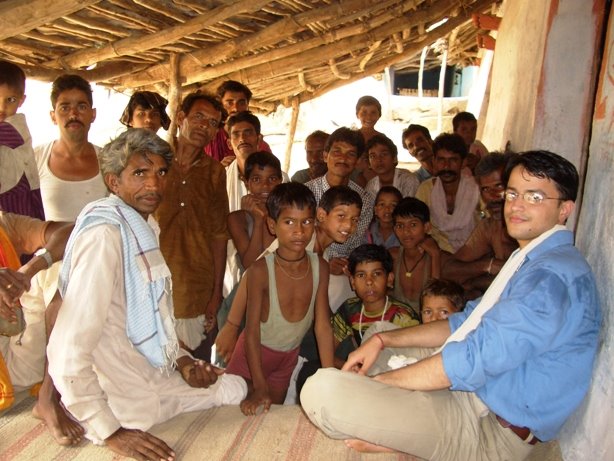
Myself with villagers in Kankerkhedi, Raghubar Singh's Dalaan Posted by Picasa

Wednesday, February 22, 2006

My days in PRADAN- The Action Begins!

The Action Begins

Soon after my village stay, I went for the real action in the grassroots. PRADAN in Sironj is Working for implementation of World Bank Aided Madhya Pradesh District Poverty Initiatives Project (MPDPIP). In Sironj block, this project is to be implemented in 46 villages and the total outlay is about 12 crores for 5 years (starting from 2000 onwards).

Before I joined PRADAN I always used to read in the newspapers/magazines that the money for development could not be utilized in the Project duration for some project or the other. I always used to think that may be the agency which is working to implement is not functioning properly. To certain extent it is true, as in most of the Indian Development Projects are like a Paralyzed Body- your head works and you come up with some really wonderful ideas, based on those ideas, you gather resources also but when it comes to execute those wonderful ideas, your limbs either do not work; or it they do, they work in an absolutely undesired way spilling your resources here, there, everywhere except the place they were meant for.

All ambitious ideas is past decades have died in this fashion and I don't see a ray of hope as at the grassroots, things have hardly changed, or if at all they change they have gone for the worse. The worst part is, we have, as individuals, accepted this chaos and most of us are either part of this orgy of corruption and mismanagement or we are ready to compromise at any point of time.

I used to think that there is no way a person can survive in the rotten system that we see around ourselves. More so, I thought that never in life can a multicrore project be run without any corruption. I was so disgusted with the system that soon after my graduation, I chose to join IIFM to get placement in an NGO because in my opinion both the Government and the Corporate sector have failed to safeguard the interests of the people. In such a state of mind, I had gone to my home- soon after my grads completed-when my father, who is a government Doctor, advised me to drop my radical views about corruption and nepotism in the system- "Or else", he said, "you won't be able to survive in this system".


A different Experience
After joining PRADAN I had an entirely different experience.

Ashok, our Team Leader in PRADAN entrusted me a cluster to 5 villages on the fringes of Sironj Block towards South. Two of them bordered with Nateran and three with Lateri Blocks of Vidisha, so soon I was leveled person on the border posting. These villages were between 15 to 25 kilometers from Sironj. The day I went to the first village named Kankerkhedi I traveled with Ashok on my Bike (A HH Splendor) for 15 odd kilometers on the state highway joining Sironj with Bhopal. It is such a pathetic road that the whole way I kept cursing Digvijay Singh, then CM of Madhya Pradesh, whose traditional constituency it was and his brother Laxman Singh was the sitting MP of Lokasabha from there. This place is hardly 100 kilometers from Bhopal, capital of Madhya Pradesh and you should travel on it on a bike to find out in what hellish situation are the roads of Madhya Pradesh lying today.

Kankerkhedi is a small village of about 35 households settled on the foothills of a plateau, on the fringes of a forest. It is not a very well to do village as the average land holding is close to half a hectare and the topography is undulating. We entered the village through a naala which was used by the villagers as a connecting road, since there was no road constructed to connect this village, about 250 meters from the main road. Although it was only about 250 meters which may sound very less to many, but during rains, it is a horrific experience to cross it and so the villagers prefer to walk on the muddy fields to reach the main road rather than walking though this naala in the rains. Unfortunately since both myself and Ashok were visiting this village for the first time in rains, none of us knew this. I decided to reach the village on the bike itself. But, the naala so full of filth that I had to literally wade through the mud with my bike. When some how I was able to reach its end, where there was the well of the village, its only source of drinking water, I faced many villagers who were there to witness this courageous exploit of crossing the naala on a bike to reach the village probably that was not achieved in past so many years.

There was a narrow alley from the end of the naala to enter the village and it was lined by mud houses on both the sides, most of them in a bad shape. This alley was very undulating and with an upward slope of about 20 degrees. This alley bifurcates into two parts further, the left one going towards the temple and the houses of the better of family of the village, the Mina Patels and the right one goes towards the Houses of Harijan Families. The alley was full of mud as well, as there is no drainage system in the village and waste water from all the houses is dumped directly in the street, and it flows down it to accumulate near the well. There are no toilets in this village and everybody, regardless of his social or financial status has to go to the nearby forest or fields to attend the calls of the nature. Occasionally the kids defecate in the naala and during the times of the rains, all this waste get accumulated near the well, and gets a chance to percolate down in this shallow well of about 20-25 meters depth. To my horror, this was their only source of water for drinking, bathing, cooking food and washing. No wonder when we settled down in the verandah of one of the hut and started conversing with the villagers, they told us that almost all of them were suffering with diarrhea at that point of time. As I watched the kids who had gathered there due to curiosity, I could see rashes in their skin and abscesses in the heads of toddlers, protruding bellies of the small kids of 3-5 years, indicating severe malnutrition and contaminated water. (At the end of my first year working in Kankerkhedi, 14 out of 150 odd villagers were dead due to mainly water borne diseases; the majority of them was of kids less than 5 years of age).

I was appalled at the nightmarish situation in which people were living in that village. I recalled the clean super highways of Bhopal and Delhi, the parks for wealthy joggers and their dogs, all amenities that we, the urban people, take for granted, most of the time. And here was another India, where there is no drinking water, no health support, no education, no roads, no electricity as if they do not exist for the state. That day, the ground realities of our country hit in the face of the India Shining and the brouhaha about the Economic Liberalization. Where is the development for these people? Are they any lesser Indians than those living in Lutyen's Delhi or Nawab's Bhopal? What shall they do? To whom shall they approach to look into these problems, that challenge their basic survival. All the actors of the rural life- PRIs, governement personnel, doctors, lawyers, moneylenders, traders, banks- every body is standing there with a knife of exploitation in their hands to claim the proverbial pound of flesh. What would have I done had my family lived in such circumstances? What would have you done? Under these circumstances is it a sin to revolt? I don't think so. I did not hate them when they did not trust me. I did not hate them when they tried to gobble the money provided by the government for their own welfare scheme. I did not hate them when they offered me a bribe which I didn't accept. I did not hate them when they took kickbacks for purchasing their own goods from the traders.

Why? Because that is what we, as a society, as a nation, taught them. For last so many decades, that is their learning. You bribe the revenue official, you get he copy of your own land records. You want money to purchase seed and fertilizers, to do farming for feeding your kids, you get a loan from the Seth at a criminal rate of interest of 36 to 60 percent per year (which none of us would ever dream to touch even). You bribe the surveyor; you get the money of insurance from the insurance company. You bribe the teacher to get admission of you child in the school. You bribe the minister to get your son in school as a teacher. You bribe the panchayat to get a hand pump dug at your doorstep. If you can't pay the bribe, you don't have a right to survive. That’s the bottom-line for the poorest of the poor. Our system does not consider them to be human beings- for it they are some advanced form of humanoid apes, whose birth or death does not affects anybody.

(continued)

Tuesday, November 15, 2005

My first Experience of Staying in a Poor Indian Village

My First Village Stay

Staying in a village immediately after joining PRADAN is a litmus test as well as an acclimatization drill for the newcomers. I was taken to a village called Chaapu, which was a pre-dominantly Gond Tribe Village, about 15 kilometers from Sironj. Not long ago, about 15 years ago, this village was totally encircled by a dense forest and people made it appoint to get back inside their homes by 4-5 o’clock every evening because Tiger roamed about in this area. But the main occupation of these landless tribal was wood cutting and they were allotted this land by the Nawab of Sironj to exploit the Khair (Acacia) trees of this area. Since they used to cut the khair trees, this community itself got a new name- ‘Khairua’. After years of reckless felling of trees, and diverting this land for the agricultural purposes, today the majestic forests exists only in the maps of the Forest department like so many other forest areas in Madhya Pradesh. Every morning the women from this village take head loads of the wood collected from the nearby scrubland and walk 15 kilometer to Sironj, where they fetch about Rs.30-40 for each head load that is sold as the fuel. They have this hand to mouth existence in which when a woman cannot go to the market for some reason, she has to look for food from her neighbours or the money lender.

Two Tribal SHGs
Sulakshana, my colleague in PRADAN, had helped these women to get themselves organized into two SHGs (Self Help Group- a group of 10-15 women associated for collecting small amount of money, 5-10 rupees a week and lending amonst themseves once the amount becomes significant) for getting easy credit within the village itself during the time of ditress. She used to hold meetings for these villages every Tuesday, in the night, when the women would be through with their household chores and would take out some time. It was one such meeting to which I was taken the second day after I joined PRADAN.

We reached the the Khairua hamlet at about 8 in the night and waited for the women to come. It took a long time till they all arrived, and this time I utilized for observing the landscape. We were in a hamlet that was on top of a hillock not very high, may be 15 meters from the fields below, on which there were a number of huts located. We sat in the verandah of one of the huts. Although it was mid April already and day time temperature was considerably high, it was very pleasant in the evening- the typical Malwa /Rajasthani climate. The women were talking to Sulakshana and asking questions to her in hushed voices, pointing me. I knew they were asking about me, and I was not surprised. The biggest surprise for these women was that PRADAN people were going unmarried even at the age of 24 that I was, because in their village, guys usually got married at a very young age, the latest being 18.

The Best Song in My Life
As we sat there, myself, Sulakshana and some women SHG members, waiting for the rest to come, they started singing some bhajans in the way that I will not forget to the last day of my life. They made two small groups of 5 women each- one group would sing a line in chorus, and the other would repeat in chorus just as the first group completes a song. It was so sweet, so natural that I was feeling that the summer breeze itself is singing the song in tune with the valley that lay in front of the hillock that we were sitting upon. The starlit sky above our heads seemed to be dancing softly in the tune of the song- “Tune kaali gai ka doodh piya, tone kali gai ka doodh piya, tu isililye kaala hai, tumhara rang kaala hai” (Mother of Lord Krishna consoling the young lad when Radha, his childhood sweetheart would tease him by telling him that he was of dark complexion- “You drank the milk from a black cow, that is why you are dark, your complexion is dark”). The song reverberates in my mind as I type these lines.

Kudos to the Spirit of the Khairua Women
These women, with no material valuable in their lives, just a few old shanties, and small patches of unproductive lands without any irrigation facility used to live their life in here and now situation, singing songs, dancing and living each day of their life as if it were the last one of their life, their life full of laughter and enjoyment despite the sorry state that they live in, the exploitation that they face on a daily basis. Those half-naked people who don’t earn enough to cover their bodies and full their guts, whose women travel everyday to the nearest market 15 kilometers away with a head load of wood weighing not less than 35 kg and come back the same day covering the same distance on feet, both way- live life king size, and we, despite having so much in our lives still carve for more and crib about how bad our lives are, looking for happiness in material assets, discotheques and pubs- what a contrast!

Moharbai and Her Clan
Next day, I was dropped into a village called Tarwariya, which was the star village of PRADAN. I was putting up with a harijan family headed by Moharbai, an elderly widow, who was a member of one of the SHGs in that village. She owns a few goats, who share the courtyard with her family members in night to sleep in. I was staying put with them, taking bath at the handpump in their side of the village, predominantly habitated by Harijans and Mehtars, both of them the most exploited and downtrodden lot of the Indian Society through the ages- sharing food, and sleeping in a group in the shared courtyard, being a part of their life- and I never felt discriminated agaist- in fact, they would take pride in a 17th pass (what villagers called a person who has completed his Post Graduation) urbane youth staying with them. I accompanied them going to the fields, were wells were being dug and kids would take the goats out for grazing. In the month of May, where Sun would bake the animals and plants alike in a parched central Indian village, where the heat wave would howl like a banshee in the deserted streets when nothing- man or animal can be seen- as everybody takes refuge inside the houses- shanties and mud structures and sleep, to wait till the heat reduces a bit and people go out to work at about 4.30 in the evening and work till darkness falls. Yet, I never heard anybody complain- they would be so calm- stithaprajna- as we call in Hindi- totally un-nerved.

Caste- Would not let go so easily
Living in the village, I made a point to give only my first name while introducing myself. The villagers would try to probe deeper to find my surname to ascertain which caste I belong to and I would deflect all such questions. They did not give up and some of them found out from my colleagues in PRADAN my surname. Some of them would call me Maharaj which I did not like due to the caste angle attached with it.

I left my home in 1997 just after the schooling for completing my graduation and Post Graduation and have been living in hotels and shared accommodation since then. The kind of camaraderie that we had in hostels negated any chances for having the caste based biases or pride in most of us. Therefore, caste was the last thing in my mind while enjoying my days in PRADAN. However, some villagers, particularly those of the so called higher strata would take me aside and ask me not to stay with Harijans lest I lose my dharma- which I out rightly rubbished, telling them that I am myself a harijan, which they would obviously not believe.

I am called back
I was so immersed in sweet and sour experience of a village stay that I forgot that I was supposed to come back to PRADAN on the 4th day. On the evening of 5th day, a villager who had visited PRADAN office for some work came to me to inform me that I am supposed to comeback the following evening to attend some important meeting. The next day I took lift from a youth of the village on his bicycle and we came paddling all the way to PRADAN office some 10 kilometers away.
(To be continued)

Thursday, October 20, 2005

My Days in PRADAN-Part 1

How it all got started

It was a dusty day of April 2002 when I started off from Bhopal for Sironj in Vidisha district of Madhya Pradesh, where I had been recruited by PRADAN (A Delhi based National NGO working for upliftment of Poor in 7 states of India) to work as an Executive. I had just passed out from IIFM, Bhopal after completing my PGDFM from there in March. It was on day minus one of the placements in IIFM that I got through for PRADAN. (PRADAN came for recruitment a day earlier than scheduled). I was keen on joining a grassroots NGO because firstly I wanted some good first hand experience of working with the community directly and then I used to feel indebted due to the money that the government spent over me while in IIFM. I had imagined that it would be a well to do place. After all, it was only 120 kms. from Bhopal, the capital of Madhya Pradesh. Vidisha is also connected by train but I had seen in the map that Sironj is somewhat away from the railway line.
“So what?'- I had thought- “ 40kms is nothing. I can cover that much within 45 minutes and get aboard a train for home”.
But that was not to be, as I later found out.

Daydreaming
As we started off from Berasia bus stand in Bhopal, on a bus labeled Non-stop, I was full of excitement. After all, it was my first job that I was going to join! I had so many visualizations about the place. I always used to imagine a one storied building, on the side of a highway (like PRADAN Office in Kesla is) and I used to think that it would be like a flat (like the Office of Amhi Amachya Arogyasathi-an NGO in Garhchirolli, Maharshtra where I had visited before). I kept thinking about the work that I would do, and kept thinking about how I would use the studies that I had carried out in IIFM.
Harsh Realities
While I was thinking the bus covered the good patch of about 40 kms of the road to Sironj. We crossed Bearasia and voila! The bus became a roller coaster ride, jumping and jerking over a road so full of potholes that I was reminding me of the surface of moon full of craters that I had seen in the National Geographic! I could not believe that roads just 40 km out of the state capital and that too in the constituency of the brother of the Chief Minister Dig Vijay Singh can be that bad.
The tire goes boom!
But, I was soon to realize that it was just a beginning. Soon, the passengers and the luggage were falling on each other alike. The bus was already overloaded but 'the beginner's luck' described in 'the Alchemist' had ensured that I get a window seat and get enough oxygen along with the dust to remain conscious to register the unprecedented travel in my life. There came a bridge on a river (Sagad-later I came to know) and right in the middle of that bridge, the rear tire of the bus went flat. I thanked my stars, not for the flat tire, but for the opportunity to get down from the bus that seemed like a cattle truck to me and become human being for a few minutes again.
I looked around and found what government records and IIFM books called Forest- a thoroughly exploited scrubland in which only the stumps of once densely found teak trees were found. It looked apologetic to me, for not looking as a forest at all to me. I was looking at the vegetables sown in the riverbed under the bridge, that the conductor of the bus started calling everybody on board. I was surprised at the speed with which they had replaced the flat tire with the spare one. Later a co passenger told me that it is so common in a day that the conductor and the cleaner have become experts in that particular activity.
Bachao-Bachao! I am kidnapped!
We moved a little ahead, and I realized that suddenly the bus has left the road and is traversing through someone's field, which, it being post harvest season was devoid of any vegetation. The bus was going away from the road, deeper and deeper in the fields and I was trying to understand what the poor devil is up to. A point came when the road could not be seen anymore and this guy is driving the bus right to the fringes of the forest, in the fields. I thought that some one has hijacked the bus, and all the passengers including yours truly have been taken hostage. I knew that I was going to join a grass-root organization and that it will definitely not pay a single penny in ransom for me, because at that point of time, they did not even know how I looked like. I looked around to see the reaction of the co passengers. Most of them had a exasperated look on their face- the face smeared with sweat, dust and the smoke- but none of them had the bewildered look that I carried on my face. They were looking sympathetically at me and I was not able to understand how these guys can keep their cool. By that time, the bus had left the fields and was deep inside the scrubland called forest. We were going through the forest tracks used by the head loaders and illegal wood cutters and the forest staff who was earning no better. Now, this was a bit too much for me.
I poked my elbow in the ribs to the co-passenger sleeping (miraculously!) besides me.
"Haan?"-he enquired, angrily on being taken out of his bumpy siesta, "What is it?"
"Bhai Saheb"- I said, trying to pacify his discomfort of being woken up in middle of a beautiful dream, may be-" Aap ko kuch gad bad nahin lag raha hai?" ( Don't you find something amiss?)
He looks up and down, right and left, and then says-"What?"
"Look around", I said- “we are in the middle of nowhere, and I think there is something terribly wrong".
"Yes it is", he says- "even the forest tracks and wheat fields of Madhya Pradesh are better than the roads that the state has!"
Bach Gaye!
True to his words, I saw the bus again changing its course, this time away from the forest and the fields and after another 15 minutes we were back again on the road, but in order to avoid the small stretch of 15 kms of absolutely horrible road (other patches are plainly horrible- there are degrees of horrible roads in M.P.!) we had spent close to one hour, going through the forests and the fields. It was my first experience of the vehicles leaving the highway and treading on the forest and the fields, courtesy Shri Dig Vijay Singh, then Chief Minister, Madhya Pradesh (his eccentric competitor, Uma Bharti gave a controversial statement later that year before the elections for MP Assembly in which she said that the public of MP would thrash Dig Vijay Singh government by dumping it in the potholes of the roads- and so it did!)
Aa hi pahuche apni manjil pe!
Finally, spending each second in the fond remembrance of the roads of Char Imli, the abode of the bureaucrats in Bhopal, where even the side lanes (meant for the mighty pets of the burra sahebs to relieve themselves) are comparable with the Western Express Highway between Mumbai and Poona, I approached the Sironj town. Surprisingly, the bus was still in one piece (congratulations TELCO!).
I saw a good building, which heightened up my spirits of finding more such buildings in my abode for next few years. It was a hospital, perched on the plateau that overlooks Sironj town. The next moment our bus was going down the plateau to reach the bus stand of Sironj.
I got down and many autowallahs surrounded me at the very instant.
"Kahan jaana hai, Sir?'- asked one.
"PRADAN Office", I said.
"Where?"- pat came the reply.
"Above Khargosh Bidi factory"-I tried to explain.
"Accha accha. Pradhan walon ke yahan jaana hai? Chaliye!" – he said, to my relief.
"PRADHAN? As in Mukhiya of the Village? Interesting!"- I could not hide my grin.
The autowallah shrugged. I got into the auto, put my luggage- An air bag and a sleeping bag- in the back and we drove off. We were crossing through roads covered with the flag stone- something that I had not seen for a long time since I went in some very interior, old streets of my home town, Rewa. Between the flagstone, there were the drains, open ones, about 3 inches wide and 5 inches deep from individual houses to the main drain that ran parallel to the road. These smaller drains had flagstone sidings and so one can actually drive a vehicle over it, without damaging either the vehicle or the drain. Also, it is very convenient for the sweepers to clean the open drains.
I looked around-Old, decrepit buildings-crumbling havelis, small fortresses- it was clear that I have arrived into a part of history studded with remains of the past.
My first Impression of PRADAN
I was looking around, when the autorickshaw stopped.
"Aa gaya, Sir"-announced the autowallah.
"Kitna"- I said, getting out of the auto with my luggage.
"Beis"-said he.
"Accha! Kuch jyada nahin hai yeh?"-I said mockingly, while taking out my wallet.
"Yahan itna hi lagta hai"-said he, bitterly.
"Ok"- I said, giving him the bill-"here you go!"
Pocketing it, he drove off without saying a word. I sighed in relief of having reached there, finally. I looked around. I was in the middle of a street, between a one storied building and a small shack, in front of which a white male goat was tied, chomping his grass. It was a four mill, an atta chakki.
I looked at the one storied building for any signs of PRADAN or Pradhan as they called it. On the balcony I noticed a small white board with the logo of PRADAN.
''There you are"-I told myself. Holding my bags, one on my shoulders, other in my hands, I looked for a staircase. Having found one on the left, I decided to climb. It was a fight of about 15 stairs and I found myself in front of the office, which was going to be my Karambhoomi (the theatre of action) for next few year.
I treaded cautiously. I peeped in the office- there was a big hall, and a wall after two thirds of the length of the hall. Built only for 6 feet, it was more of a partition then a permanent structure. The hall was empty, but I could hear voices of some people talking. I looked around and found a shelf in the wall, just after the entrance. There was a packing box for computer.
"Wonderful!"- I thought- "Atleast one can watch movies by getting some CDs here".
(Later on, my expectations proved to be misplaced, because this was an old 486 kind of computer, sightly more modern- on which even ms Word would not run properly, forget about a video CD. Anyways, there was no CD drive in this box of a computer!)
"Hmmmm" - I said, looking at the charts put on the wall. These were all in Hindi, about the various activities like SHGs, agriculture etc. I the mean time I could hear a female voice, as I closed in to the partitioned part of the office. I decided to surprise the people at the other end. I entered the room with my bags on my shoulders and came face to face with a good looking, spectacled female of about my age.
"Hi!"- I said- "I am Prashant, and I have come here to join you guys!"
Oye-Hoye !
She looked at me with a bewildered look and then said -"Hi! Have you come here on a two month summer training program? "-looking at the little luggage I was carrying over my shoulders.
"No", I said, "I am here to join PRADAN as an employee".
"Really? But looking at your luggage, I thought you are here for a short period of time" She said.
"I don't need much luggage to sustain myself"- I told her- "and in any case I would be going back to Bhopal to get my books and all!"
"Ok"- she said, "Let me introduce you to the others.” She took me to the other corner of the office.
"Here"-she told a middle aged person on a s-chair- "He is Ashokji, he is our Team Leader, and Ashokji, he is Prashant, he has come to join PRADAN."
"Welcome!"-said the Team Leader.
(to be continued.................................)